
An outdoor kitchen lives in one of the harshest environments on your property. It takes sun, rain, heat cycles, humidity, and in some regions salt air and pool chemicals, every day, with no roof and no off season. The materials it is made of decide how it looks in year ten. This guide covers the two decisions that matter, the surface you cook and prep on and the structure underneath it, and how the common material choices hold up once they are outside.
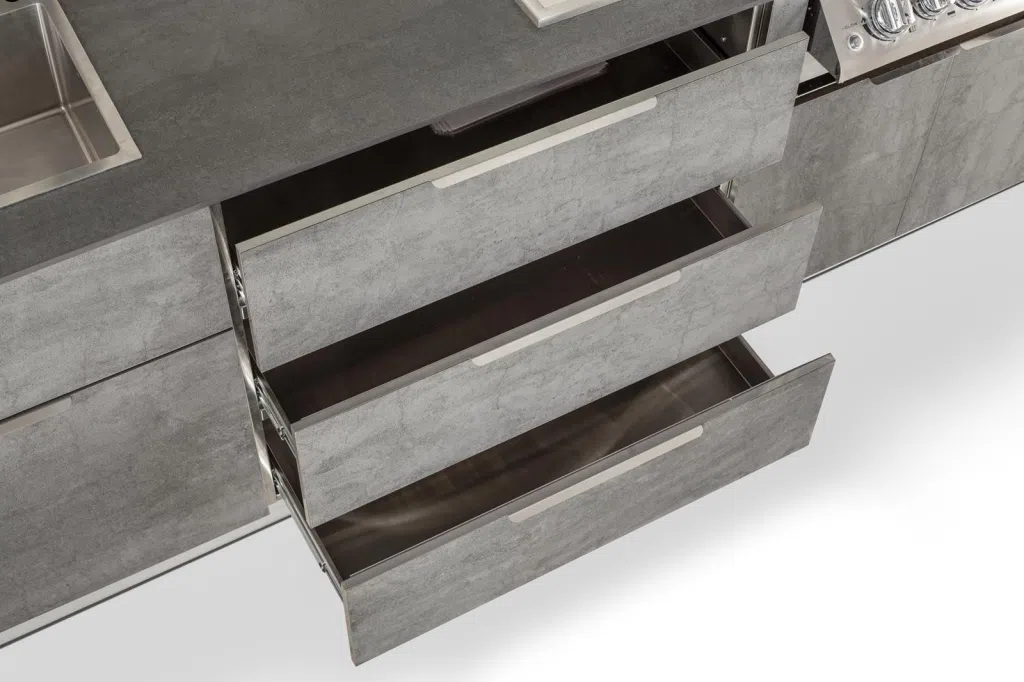
What should an outdoor kitchen be made of?
There are two material questions, not one. The first is the surface: the countertop and the visible faces you touch, cook near, and look at. The second is the structure: the cabinet body that holds everything up and lives in the weather every day. Buyers tend to focus on the countertop and assume the structure will take care of itself. Outdoors it is the other way around. A beautiful countertop on a structure that rusts or swells is a short term kitchen. The materials below are grouped so you can weigh each decision on its own.
What are the most common outdoor kitchen countertop materials?
Five surfaces show up most often outdoors, and they are not equal once the weather gets to them.
- Granite. A natural stone that handles heat well and looks substantial. Most granite is porous, so it generally needs periodic sealing to resist oil and wine stains, and darker slabs can fade under constant UV.
- Concrete. Can be cast to any shape and looks architectural. It is porous and typically needs sealing, and it can crack or craze over time with heat and freeze cycles.
- Tile. Affordable and heat tolerant on the tile face, but the grout lines are the weak point outdoors, where they stain, harbor moisture, and break down.
- Porcelain and sintered stone. Engineered surfaces fired at high heat. Sintered stone is non porous, so it does not need sealing, and it resists heat, scratches, stains, and UV. This is the surface SKOL uses.
- Stainless steel surfaces. Durable and hygienic, but appearance depends entirely on the grade, and lower grades tea stain and show corrosion at the welds outdoors.
What is the best material for an outdoor kitchen countertop?
For a surface that stays outside all year with the least maintenance, sintered stone is the strongest all round choice, which is why SKOL specifies it on every visible face. It is non porous, so there is no sealing schedule and no gradual staining from organic matter. It resists the heat of a hot pan, the edge of a knife, and years of UV without fading. Granite and concrete can look the part and perform acceptably with upkeep, but upkeep is exactly what most people stop doing after the first year. The best material is the one that still looks right in year ten without a maintenance ritual, and outdoors that points to sintered stone.
Why does the structure material matter as much as the countertop?
The countertop is spared the worst of the weather because the structure underneath takes it first. If that structure is the wrong material, the kitchen fails from the inside out regardless of how good the surface looks. Stainless steel is the common structural choice, but stainless is a category, not a grade. SKOL builds every cabinet on 304 stainless steel certified to the ASTM A240 standard, the grade specified for commercial kitchens and marine environments, with the certification verified batch to batch rather than assumed. Each module is also fully enclosed and elevated off the ground on adjustable legs, so moisture, pests, and dust stay out and water drains away beneath the units. The surface gets the attention. The structure decides the outcome.
- 304 stainless steel in depth: why the grade and the certification matter outdoors
Which outdoor kitchen materials last the longest?
Longevity outdoors comes down to two properties: corrosion resistance in the structure and non porosity in the surface. A certified stainless structure resists the rust and tea staining that end most outdoor kitchens quietly, at the welds, years after the builder has gone. A non porous surface resists the staining and sealing failures that age a countertop. SKOL pairs 304 stainless certified to ASTM A240 with a sintered stone exterior for exactly this reason, and the full system carries ISO 9223 category CX certification, the most severe corrosion classification in that standard, along with a lifetime structural warranty. Materials that last are not the ones that look best on day one. They are the ones that are still performing when the day one finish would have failed.
How does SKOL choose materials?
The choice is deliberate, not decorative. Certified 304 stainless steel goes where strength and corrosion resistance matter, in the cabinet bodies, drawer systems, and adjustable legs. Sintered stone goes on every surface that hands, knives, heat, and weather touch. Nothing is coated or painted over the structure, so there is no painted layer to scratch through to bare metal. The finish options change the appearance of the kitchen; they do not change the durability specification, which is the same on every SKOL build. You choose how it looks. The performance is standard.
Frequently asked questions
What is the best material for an outdoor kitchen countertop?
For year round outdoor use with the least maintenance, sintered stone is the strongest all round choice. It is non porous, needs no sealing, and resists heat, scratches, stains, and UV. Granite and concrete can perform acceptably but generally require periodic sealing to avoid staining. SKOL uses sintered stone on every visible surface.
Are granite countertops good for an outdoor kitchen?
Granite handles heat well and looks substantial, but most granite is porous and generally needs periodic sealing to resist oil and wine stains, and darker slabs can fade under constant UV. It can work outdoors with upkeep, which is the part most homeowners stop doing after the first year.
What is sintered stone and is it good outdoors?
Sintered stone is an engineered surface fired at high heat into a dense, non porous slab. Outdoors it resists heat, scratches, stains, and UV without sealing, which makes it well suited to a surface that stays exposed all year. It is the exterior material on every SKOL module.
What is the most weatherproof outdoor kitchen material combination?
A certified stainless structure paired with a non porous surface. SKOL builds on 304 stainless steel certified to ASTM A240 and finishes in sintered stone, with fully enclosed, elevated cabinets. The system carries ISO 9223 category CX certification and a lifetime structural warranty.
Related
- Sintered stone surfaces
- The four SKOL configurations
- Outdoor kitchen cabinets
- Modular vs traditional outdoor kitchens
See the materials in your own configuration. Design your kitchen in SKOL 360, free and in your own backyard through augmented reality, and compare sintered stone finishes as you build. Or book a conversation to talk through the material choices for your space. No pressure, no urgency.