
Most outdoor kitchens are built one of two ways. A traditional kitchen is constructed by hand on your patio, framed and finished in place like a small building. A modular kitchen is manufactured as a set of finished cabinet units and assembled on site. Both can produce a kitchen you are happy with. They differ in how they are built, what they are made of, how long they take, and what happens to them over the years that follow. This page lays out the comparison plainly, including the cases where a traditional build is the better choice.
What is the difference between a modular and a traditional outdoor kitchen?
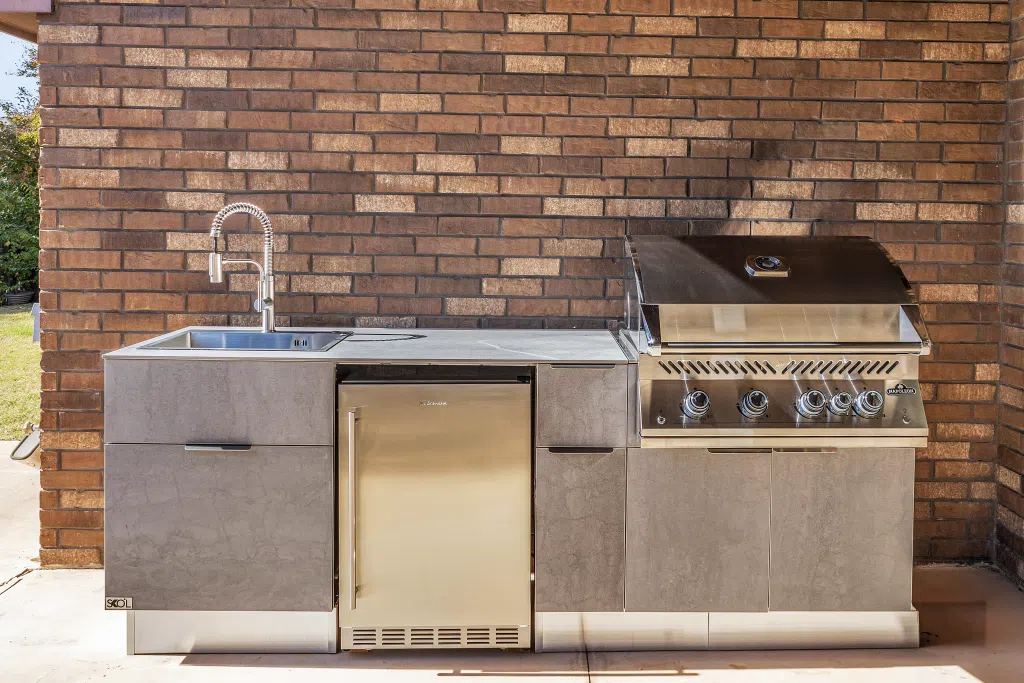
A traditional outdoor kitchen is site built. A crew frames a structure on your patio, usually in block or steel studs, then clads it in stone, stucco, or tile and cuts openings for the appliances. It becomes a permanent fixture. A modular outdoor kitchen is made of pre engineered cabinet modules manufactured in a controlled facility, then combined on site into a finished kitchen. A SKOL module is a fully enclosed cabinet, sealed on every side, built on a 304 stainless steel structure with a sintered stone exterior, and elevated off the ground on adjustable legs. The traditional kitchen is assembled from raw materials at your home. The modular kitchen arrives already finished.
How do modular and built-in outdoor kitchens compare on construction and timeline?
A built in kitchen is a construction project. It brings framing, masonry, dust, and a crew on site for days or weeks, and the result depends on the skill of the people doing the work that week. A modular kitchen skips the construction phase because the modules are already built. Installation is typically measured in a day rather than weeks, with no framing and no masonry in the backyard. The trade is straightforward: a built in kitchen is shaped to your patio in place, while a modular kitchen is manufactured to a fixed standard and set on site. For homeowners who want a predictable outcome and a short install, modular removes most of the variables. For those who want a structure integrated into existing hardscape and are comfortable with a longer build, traditional remains a valid path.
Stainless steel or stone: which materials last outdoors?
This is really two questions, because a durable outdoor kitchen needs both a structure and a surface, and the best answer uses each material where it is strongest. Stone surfaces such as granite, concrete, and tile are common on traditional builds. They look substantial, and some hold up well, but many need periodic sealing, can stain from oil or wine, and can crack or craze under heat and freeze cycles. Stainless steel is the common structural choice, but stainless is a category, not a grade, and lower grades tea stain and rust at the welds outdoors. SKOL builds every module on 304 stainless steel certified to the ASTM A240 standard, the grade specified for commercial kitchens and marine environments, and finishes every visible face in sintered stone, a non porous engineered surface that resists heat, scratches, stains, and UV without sealing. Certified steel carries the load and resists corrosion. Sintered stone takes the daily contact. The comparison is less stainless versus stone than it is which stainless and which stone.
- 304 stainless steel: why the grade matters
- Sintered stone surfaces: heatproof, scratch resistant, stain proof
Can you build an outdoor kitchen without masonry or concrete?
Yes. A traditional kitchen usually needs a poured pad or a masonry base, which is one reason the build takes as long as it does and why it cannot be undone easily. A SKOL kitchen stands on independently adjustable stainless steel legs, so it levels on pavers, stone, concrete, or a structurally sound deck without pouring a new pad. That matters most for deck installs and finished patios, where cutting in footings is disruptive or impossible. It also means the kitchen sits above the ground rather than on it, so water drains away beneath the units instead of pooling against them.
Which is better for the long term, modular or traditional?
The long term difference is serviceability. A built in kitchen is finished the day it is done, and its appliance openings are sized to the models chosen that year. When a grill is discontinued in eight years, a masonry cutout has to be rebuilt to fit its replacement. Because SKOL is modular, appliance openings are not locked to one manufacturer’s day one dimensions, so a module accepts a replacement. The kitchen can also be reconfigured, expanded with more modules, or relocated if you move. A masonry kitchen is a permanent fixture you leave behind. A modular kitchen is a set of cabinets you continue to own. The SKOL system carries ISO 9223 category CX certification, the most severe corrosion classification in that standard, and a lifetime structural warranty.
When does a traditional build make more sense?
A traditional build can be the right answer when the kitchen has to match existing masonry exactly, when the design calls for curved or fully bespoke geometry that a modular system does not offer, or when a homeowner specifically wants a permanent structure and has no interest in ever moving or reconfiguring it. Honesty about that is part of the comparison. SKOL is built for people who value a manufactured, certified, serviceable system with a short install. It is not the only legitimate way to build an outdoor kitchen, and the point of this page is to help you decide, not to claim there is only one answer.
Frequently asked questions
What is the difference between a modular and a traditional outdoor kitchen?
A traditional outdoor kitchen is built by hand on site from masonry or framing and becomes a permanent fixture. A modular outdoor kitchen is made of factory built, fully enclosed cabinet modules that arrive finished and combine into any layout. Modular installs in a fraction of the time and can be reconfigured or relocated, while a traditional build is shaped to your patio in place.
Is a modular outdoor kitchen better than a built in one?
They solve different problems. A built in kitchen is permanent, sized to day one appliances, and only as consistent as the crew that builds it. A modular system is manufactured to a standard, accepts appliance swaps, can be reconfigured or relocated, and installs in a fraction of the time. For most homeowners the deciding factors are certainty of outcome and long term serviceability.
Can an outdoor kitchen go on a deck without concrete?
Yes. SKOL modules stand on independently adjustable stainless steel legs, so the kitchen levels on pavers, stone, concrete, or a structurally sound deck without pouring a new pad. Traditional builds usually require a masonry base or poured slab.
Stainless steel or stone: which is better for an outdoor kitchen?
A durable outdoor kitchen uses both. SKOL builds the structure from 304 stainless steel certified to ASTM A240 for strength and corrosion resistance, and finishes every visible surface in sintered stone, which resists heat, scratches, stains, and UV without sealing. The grade of the steel and the type of stone matter more than the general category.
Related
- Outdoor kitchen materials overview
- Sintered stone surfaces
- The four SKOL configurations
- Outdoor kitchen design and layouts
- What an outdoor kitchen costs
Compare the two approaches on your own space. Design your kitchen in SKOL 360, free and in your own backyard through augmented reality, with pricing that updates as you build. Or book a conversation with our team to talk it through. No pressure, no urgency.